REVIEW · CANMORE
The Sights of Canmore: a Smartphone Audio Walking Tour
Book on Viator →Operated by Tripvia Tours · Bookable on Viator
Canmore’s story is waiting on your phone. This smartphone audio walking tour guides you around town with live GPS and a fun location-based trivia game, while key stops highlight the coal-mining era and the quirky symbols people use to remember Canmore. I especially like the easy pace and the humor in the commentary, but the one thing to watch is setup: you’ll want to download the tour before you start and keep an eye on phone battery.
You can walk at your own rhythm. The route is roughly 5 km round-trip and designed so you can start, stop, and resume whenever you want (no timed group herding). The trade-off is that a “self-guided but guided” experience means you’ll get the most out of it if you’re willing to pause and look up at monuments, murals, and viewpoints instead of just covering ground.
In This Review
- Key takeaways before you hit the sidewalk
- A smartphone tour that feels like a local stroll, not a crowd event
- Price and value: $8.22 for a lot of guided walking
- Getting set up: Wi‑Fi download, live GPS, and no data stress
- How long it takes and what pace to plan for
- Stop-by-stop: from galleries to the Big Head that names the town
- Stop 1: Three Sisters Gallery
- Stop 2: Bow Valley Trail & Railway Avenue
- Stop 3: Sidney Street & Bow Valley Trail (the red telephone box)
- Stop 4: Hospital Place & Bow Valley Trail (black bear sculpture)
- Stop 5: Bow Valley Trail & 13 Street (grizzly bear sculpture)
- Stop 6: Bow Valley Trail & 15 Street (views and mountain names)
- Stop 7: Bow Valley Trail & 17 Street (inukshuk)
- Stop 8: Railway Avenue & Bow Valley Trail (coal mining cars monument)
- Stop 9: Policeman’s Creek Boardwalk
- Stop 10: 10 Street & 6 Avenue (Mount Rundle view)
- Stop 11: 719 10 St (mural of Isabelle Dube)
- Stop 12: Canmore Museum and Geoscience Center
- Stop 13: Friendship Park
- Stop 14: 8 Avenue & 6 Street (Main Street stroll)
- Stop 15: Canmore Inn & Suites (1890)
- Stop 16: Canmore Miners’ Union Hall
- Stop 17: Centennial Park (Three Sisters, Stan Rogers, events)
- Stop 18: Ralph Connor Memorial United Church Canmore
- Stop 19: NWMP Barracks
- Stop 20: Big Head Sculpture (town name connection)
- The trivia game: optional, but it helps you slow down
- What I think works best for different kinds of visitors
- Should you book this Canmore smartphone audio walk?
- FAQ
- How much does The Sights of Canmore smartphone audio walking tour cost?
- How long is the tour?
- Is there an admission fee for all stops?
- Do I need cell service or data during the walk?
- Where does the tour start and end?
- Is the tour offered in English?
- Can I do it at any time of day?
Key takeaways before you hit the sidewalk

- Live GPS that plays commentary when you arrive so you’re not guessing where to go next
- Start/stop anytime along the route, which is great when weather or energy changes
- Coal-mining and law-and-order stops (including coal mining cars, Miners’ Union Hall, and the NWMP Barracks) that explain why Canmore looks the way it does
- Animal sculpture comparisons that turn a quick walk into a mini lesson about Rocky Mountain bears
- Mountain-name trivia points for serious Canmore trivia fans and casual photo-takers
- Big Head Sculpture explained as part of how the town got its name
A smartphone tour that feels like a local stroll, not a crowd event

The big win here is the format. You download a mobile ticket and then follow the route at walking speed, with the audio guide triggering automatically as you get close to each stop. There’s no tight schedule, no packed group, and no awkward “waiting for stragglers” moment.
I like that the tour is designed to keep you moving but not rushed. Many stops are brief, so you’re constantly getting a new reason to look around. And since it’s marked as a private activity for just your group, it can work well for families, couples, or friends who don’t want to coordinate with strangers.
One practical thought: because it’s location-based, you’ll want enough cell service only insofar as it helps your phone, but the key promise is that the tour is meant to run without needing signal during the walk.
You can also read our reviews of more walking tours in Canmore



Price and value: $8.22 for a lot of guided walking

At $8.22 per person, this is a low-cost way to add meaning to a town walk. You’re paying for narration plus a route plan plus optional trivia questions at each stop.
That cost matters most if you’re the kind of person who normally walks past plaques and sculptures without reading them. If you actually stop and listen, the route gives you a structured story arc: rail and mining, local institutions, memorable public art, then the mountain views and town-name legend at the end.
It’s also smart that the tour doesn’t try to charge extra at every step. Most stops don’t require separate admission, and even the ones that do are clearly marked so you can decide what’s worth paying for.
Getting set up: Wi‑Fi download, live GPS, and no data stress
Before you go, download the tour on Wi‑Fi. The important detail is that you don’t need signal or data during the walking portion, which makes the experience more predictable in towns where reception can vary.
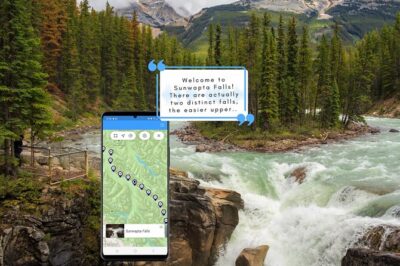
You’ll also get a live GPS map showing your route and where you are. In practice, that reduces the “where do we turn next?” friction. You still walk, but the app handles the navigation cues so you can focus on the sights.
One more setup rule that’s easy to miss: the number of travelers you select is the number of devices you can download the tour to. So if your group is sharing one phone, the experience isn’t set up for multiple listeners at once.
How long it takes and what pace to plan for
Think about 1 hour 30 minutes to 2 hours for the full loop. The route covers roughly 5 km (return), and the stop cadence reflects that: most points of interest are short (around 3 minutes), with two longer stretches:
- Policeman’s Creek Boardwalk for about 10 minutes
- Centennial Park also for about 10 minutes
If you’re stopping for photos, slowing down for viewpoints, or stepping into a museum, you’ll add time. If you’re consistent with listening and keep moving, you’ll likely finish near the lower end.
Stop-by-stop: from galleries to the Big Head that names the town
Here’s what you’ll actually cover, and why each stop is worth your time.




Stop 1: Three Sisters Gallery
You begin at 909A Railway Ave, and the first stop points you toward the Three Sisters Gallery. The tour frames this as a chance to see Canmore’s key attractions and sculptures while also touching the coal-mining days through historical buildings and local context.
This is a good “on-ramp” stop. You’ll get your bearings, learn how the app will work, and start the story with the coal-mining era as the backbone. Just note that admission there is listed as not included, so you can treat it as an optional add-on if it’s open and you want to go inside.
Stop 2: Bow Valley Trail & Railway Avenue
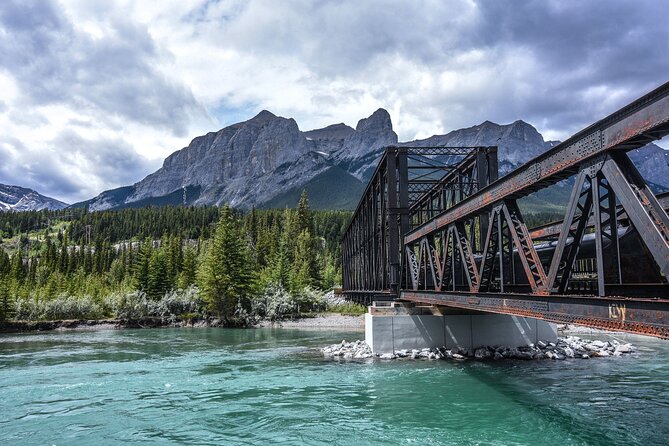
Crossing railway tracks is where the tour begins to explain the big force that shaped Canmore’s growth: the Canadian Pacific Railway. This stop is quick, but it matters because it gives you a framework for why the town’s layout and development link back to transport and industry.
If you like understanding how towns grew, take a moment here to look at the tracks as more than scenery.
Stop 3: Sidney Street & Bow Valley Trail (the red telephone box)
At this intersection, you’ll find a British red telephone box. The audio uses it as a starting point to explain what people may recognize from photos but rarely understand in detail.
This is a classic “small object, big story” stop. It’s short, but it keeps the tour from feeling like only plaques and monuments.
Stop 4: Hospital Place & Bow Valley Trail (black bear sculpture)
Next up is a black bear sculpture. The audio connects it to black bears in Canmore and the Rocky Mountains, which turns a public-art detail into something you can carry into the rest of your hikes.
If you’re planning time in the backcountry later, this kind of quick animal literacy is useful. It’s also a good reminder to stay alert in bear country.
Stop 5: Bow Valley Trail & 13 Street (grizzly bear sculpture)
Then comes the grizzly bear sculpture, with a direct comparison to black bears. This stop is valuable because it doesn’t just point at animals; it highlights differences, which helps you read what you see later on trails.
You can treat this as your “bear cheat sheet” stop, delivered in a way that fits a walk.
Stop 6: Bow Valley Trail & 15 Street (views and mountain names)
Here you get one of the tour’s payoff moments: a view of mountains to the north plus a naming lesson. You’ll hear how Princess Margaret Mountain, Squaw’s Tit, Mount Charles Stewart, Mount Lady MacDonald, and Mount Grotto got their names.
This is one of the best stops if you like Canmore trivia and don’t mind a little context. The drawback is simply that viewpoints are weather-dependent. If skies are clear, this is a highlight; if not, you may want to keep expectations flexible.
Stop 7: Bow Valley Trail & 17 Street (inukshuk)
A large inukshuk appears next, with commentary on what inukshuks are and why they’re important in the landscape.
This is a quick stop, but it’s the kind of cultural marker you’ll appreciate more after you hear the explanation.
Stop 8: Railway Avenue & Bow Valley Trail (coal mining cars monument)
Then you reach the monument that anchors the tour’s theme: coal mining cars. The audio explains how mining was a major factor in Canmore’s early days, and why these reminders matter when you’re trying to understand the town’s identity.
If you came for history, this is one of the core moments. It also helps the later civic buildings feel connected, not random.
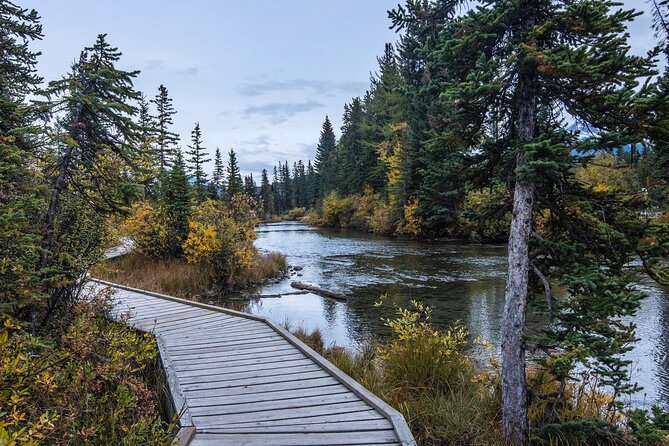
Stop 9: Policeman’s Creek Boardwalk
The Policeman’s Creek Boardwalk is the tour’s walking breath. You’ll be guided along a portion of the boardwalk and learn about the Bow River, the Canmore Nordic Centre, and references to festivals and events.
This stop also earns extra time (around 10 minutes), so slow down a touch. It’s where the walk turns scenic instead of strictly interpretive.
Stop 10: 10 Street & 6 Avenue (Mount Rundle view)
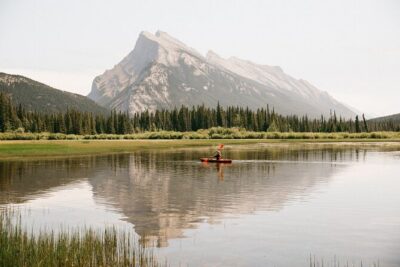
You’ll be pointed toward an incredible view of Mount Rundle. The tour shares what it knows about the mountain, which is helpful if you plan to photograph it or notice it again later.
This is another “pause and look” stop. If you’re the kind of person who takes photos while walking, try standing still for the audio moment so you don’t miss what it’s guiding you to notice.
Stop 11: 719 10 St (mural of Isabelle Dube)
At 719 10 St, the tour points out a mural of Isabelle Dube and explains the tragic story behind it. It’s a heavier tone than some of the animal sculptures and bear comparisons, but that realism is part of how you understand a place.
This is one you’ll likely remember after the tour. Even when you only spend a few minutes, the audio gives the mural a context beyond its visual impact.
Stop 12: Canmore Museum and Geoscience Center
You’ll see the Canmore Museum and Geoscience Center, described as having over 10,000 artifacts and welcoming visitors since 1984. Admission is not included, so you can decide whether to add it.
Even if you don’t go inside, seeing the museum location during a walking tour helps connect local stories to longer-term collecting and interpretation.
Stop 13: Friendship Park
Next is Friendship Park, where the tour highlights a connection between the town of Canmore and the Japanese city of Higashikawa. It’s a small park stop, but it reframes Canmore as a place with international ties, not just a mountain town looking inward.
Stop 14: 8 Avenue & 6 Street (Main Street stroll)
Now you’re on Main Street energy: the tour points you along 8 Avenue & 6 Street to see the shops, restaurants, and galleries that define daily life in town.
This stop works well as a reset. After monuments and interpretations, it’s a chance to feel the town in motion, even if you don’t plan to shop.
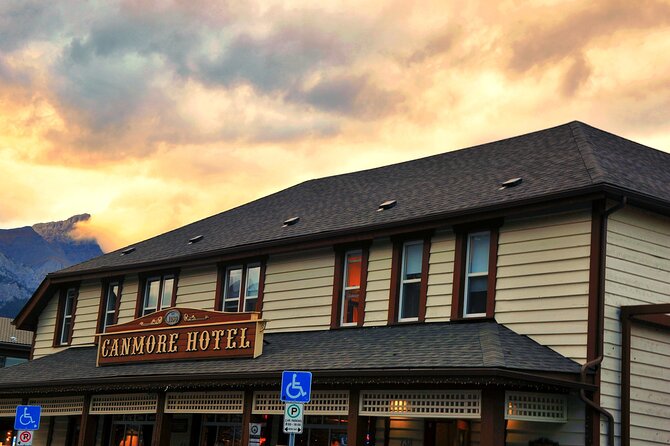
Stop 15: Canmore Inn & Suites (1890)
You’ll point out the Canmore Inn & Suites, with a detail that makes it feel anchored in deep time: it was built in 1890 by Count Eugene de Rambouville. This stop gives the tour a “human settlement” angle, not just industry.
If you love old buildings, take extra time looking at the details here—this is one of the few stops that explicitly links architecture to a named person.
Stop 16: Canmore Miners’ Union Hall
The audio focuses on the Canmore Miners’ Union Hall, including the often tense relationship between miners and the town. This is where the tour’s mining theme matures from “what happened” into “how it felt” for people involved.
It’s still quick, but it’s one of the most important cultural and historical buildings on the route.
Stop 17: Centennial Park (Three Sisters, Stan Rogers, events)
At Centennial Park, you’ll explore three points: a view of the Three Sisters Mountains, the Stan Rogers stage, and references to annual events and festivals.
This stop is both scenic and community-focused. If you’re in town during a festival season, the audio context may make what you see outside feel more meaningful.
Stop 18: Ralph Connor Memorial United Church Canmore
The tour points to Ralph Connor Memorial United Church Canmore, noted as one of the earliest Presbyterian churches built in Alberta. You’ll also hear about the mystery behind its name.
This is a short stop, but the “mystery” angle can be fun. It’s also a reminder that religious and civic buildings often carry names that reflect broader community stories.
Stop 19: NWMP Barracks
You’ll then visit the NWMP Barracks, described as one of Canmore’s most important attractions. The audio explains how the barracks played a role in maintaining law and order during Canmore’s rougher early days.
This stop pairs well with the Miners’ Union Hall because it sets up the push-and-pull of authority versus labor during growth.
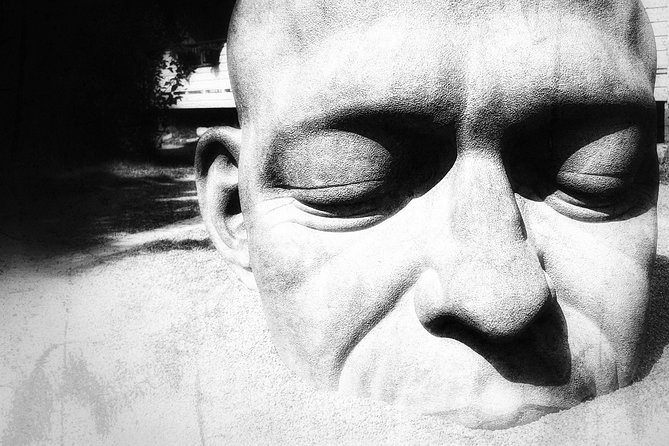
Stop 20: Big Head Sculpture (town name connection)
Finally, you reach the Big Head Sculpture, and the tour ties it directly to how the town name is associated with the sculpture. It’s a playful end to a walk that starts in industry and ends in identity.
If you came for the humor and the light moments, this is the payoff. If you came for history, it still lands because it shows how towns turn serious events into memorable symbols.
The trivia game: optional, but it helps you slow down
The tour includes a fun location-based trivia game at each stop. After the commentary plays, you tap your guess at the answer on your device.
The trivia is optional, which is great if you prefer listening without testing yourself. But I like it as a pacing tool: it nudges you to pay attention just long enough for the facts to stick.
What I think works best for different kinds of visitors
This is a strong fit if you:
- Want a guided walk that avoids crowds and schedules
- Like history that connects to buildings, monuments, and public art
- Prefer short audio pauses over long museum sessions
- Enjoy easy navigation with a live GPS map
It may be less ideal if you:
- Hate stopping often or tend to rush through streets
- Want a full indoor experience, since only some stops require admission (and those tickets are not included)
- Have a phone with low battery and no willingness to manage power
Should you book this Canmore smartphone audio walk?

Yes, I’d book it if your goal is to understand Canmore in about two hours—without paying for a formal guided group tour. The value is in the combination: industry and people, quick cultural stops, and clear payoff viewpoints like Mount Rundle and the mountain-name explanation to the north.
If you want a structured “first day in town” route, this does the job. If you already know the basics and you’re only chasing photos, you might find some audio stops feel brief—but the route’s flexibility lets you repeat the best parts or slow down where you care most.
FAQ
How much does The Sights of Canmore smartphone audio walking tour cost?
It costs $8.22 per person.
How long is the tour?
Plan for about 1 hour 30 minutes to 2 hours.
Is there an admission fee for all stops?
Most stops are free, but some attractions are listed as not included, including Three Sisters Gallery and the Canmore Museum and Geoscience Center.
Do I need cell service or data during the walk?
No. You should download on Wi‑Fi before you start, and the tour is designed so you don’t need signal or data during the walking portion.
Where does the tour start and end?
It starts at 909A Railway Ave, Canmore, AB T1W 1P3, Canada, and it ends back at the same meeting point.
Is the tour offered in English?
Yes, it’s offered in English.
Can I do it at any time of day?
The listed opening hours are Monday through Sunday, 12:00 AM to 11:30 PM, and it also supports flexible use so you can complete it at a time that works for you.
If you want, tell me when you’re visiting Canmore (month helps for weather and daylight), and I’ll suggest a smart time of day to do this loop and where to pause longest.