REVIEW · ALBERTA
Yoho National Park Self-Guided Driving Audio Tour
Book on Viator →Operated by Guide With Action · Bookable on Viator
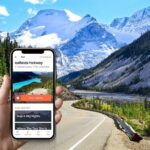
Turn on your car, and the park talks back. This Yoho National Park self-guided driving audio tour strings together GPS-based stories with major scenery stops, from Kicking Horse Pass all the way to Emerald Lake. I especially like the offline maps plus the fact that the audio plays on its own based on where you are, so your day stays relaxed instead of constantly messing with your phone.
I also love the simple freedom: you start when you want, pause for photos or a snack, then jump back in without getting “behind” a guide. One thing to consider up front is that a Yoho National Park entrance pass is required and isn’t included, and the audio experience depends on getting the app set up correctly before you start driving.
In This Review
- Key highlights worth your time
- What this Yoho driving audio tour is really like
- Route and timing: start at Lake Louise, end at Emerald Lake
- How the audio works (and how to avoid the most common headaches)
- The story-led stops: Yoho’s highlights, in order
- Kicking Horse Pass: why it’s called Kicking Horse
- Sherbrooke Lake Trailhead: a quick story, or a real hike
- Lower Spiral Tunnel Viewpoint: rail engineering meets mountain scale
- Takakkaw Falls detour: only in July to September
- Wapta Mountain: a First Nations name with mountain cred
- Burgess Shale: fossils and the scale of geologic time
- Natural Bridge: how the Kicking Horse River shapes the rock
- Emerald Lake finale with Tom Wilson
- Price and value: what $14.99 per group really gets you
- Who should book this Yoho audio tour
- Practical tips for a smoother day on these roads
- Should you book this Yoho National Park self-guided driving audio tour?
- FAQ
- Is a Yoho National Park entrance pass included?
- How much does the Yoho driving audio tour cost?
- How long does the tour take?
- Where does the tour start and end?
- Do I need cell service to use the audio?
- When do I need to download the tour?
- How do I hear the audio in the car?
- Can I start and pause whenever I want?
- What’s the cancellation policy?
Key highlights worth your time
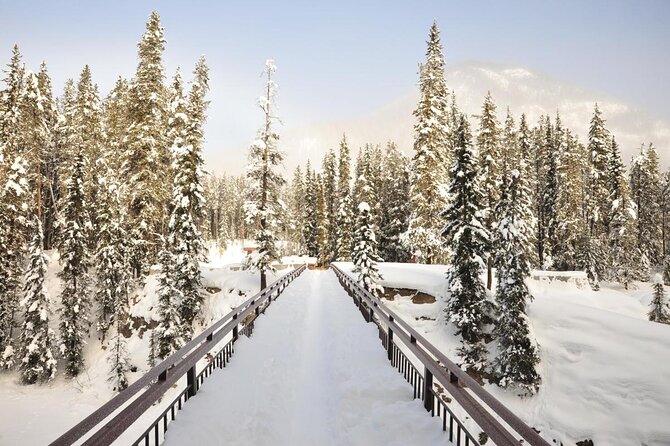
- Audio tracks tied to your exact location: hands-free playback as you pass each stop
- A 50+ mile route with 27+ stories: enough time to learn without feeling rushed
- Offline support: download first on strong connectivity, then keep going in the park
- Real detours, not just views: Takakkaw Falls in season, plus the option of Sherbrooke Lake hiking
- Big history in short segments: First Peoples context, Canadian rail era problem-solving, and early European naming stories
What this Yoho driving audio tour is really like
This isn’t a live tour bus where everyone stares at the same spot at the same time. Instead, you drive a curated loop through Yoho National Park with an app that triggers audio stories as you reach each waypoint. The whole route is over 50 miles long and takes about 1 to 2 hours to complete at a normal pace, with more than 27 audio stories along the way. That structure is great if you want learning + scenery, but you don’t want someone else pacing your stops.
The format is also built for real road-trip behavior. You can stop when a viewpoint catches your eye, pause the audio, and return to the next story when you’re ready. In other words, it fits how most people actually enjoy parks: slow enough to notice details, fast enough to still feel like you “got a route.”
One more practical note: the tour is priced per group (up to 4). So if you’re traveling as a small carload, the cost can feel pretty friendly compared with paying per person for a guided bus outing.
You can also read our reviews of more guided tours in Alberta

Route and timing: start at Lake Louise, end at Emerald Lake
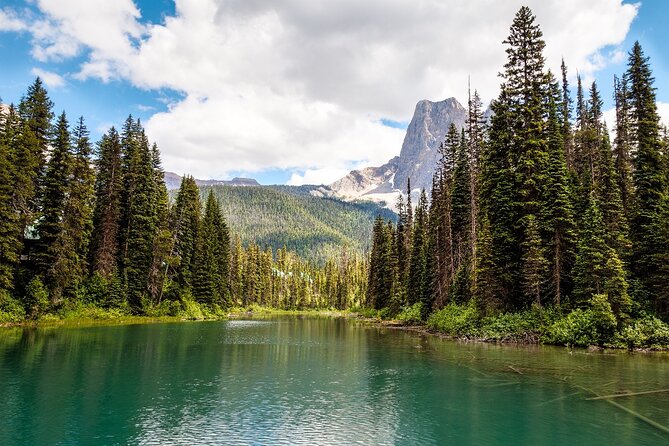
Your starting point is on the Lake Louise side of the area (CRHF+Q24, Lake Louise, AB). The tour is designed to finish at Emerald Lake Road in Field, BC. The driving portion is short enough that you can wrap it into a bigger day, but you’ll still have time for the main pull-offs.
The official opening window listed is 9:00 AM to 5:00 PM (year range shown in the booking details). If you’re traveling in late autumn or winter, just make sure the timing lines up with daylight and road conditions in the broader area.
Also keep expectations realistic: some of the “stops” are just viewpoints with a short story. Others are tied to a hiking trail option you can choose to do (more on that below). Your actual day time can stretch if you take the hikes.
How the audio works (and how to avoid the most common headaches)
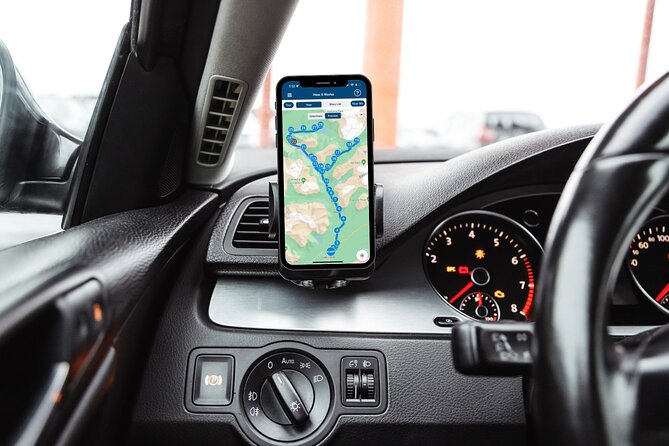
You’re using Action’s Tour Guide App. After booking, you’ll get setup instructions and a password by email and text. The big rule is that you must download the tour while you have strong Wi‑Fi or cellular connectivity. After download, it’s meant to work offline with no signal or Wi‑Fi.
When you arrive, you open the app at the onsite starting point. There’s no guide waiting at a table, so the app does the heavy lifting: you enter the first story point and the audio should begin automatically. After that, audio cues play based on your location as you follow the tour route.
For sound quality, you can connect your phone to your car stereo using Bluetooth, USB, or AUX. If you drive with Apple CarPlay, audio playback is compatible (navigation features are listed as coming soon). Android Auto is also described as on the way.
If you want a sanity check before you head into the park: load the app, confirm the tour downloads successfully, and test playback while you still have cell service. One set of user feedback complained that it never worked, and the provider’s troubleshooting advice boiled down to this: download in good connectivity, then make sure you launch the tour at the right starting point.
The story-led stops: Yoho’s highlights, in order
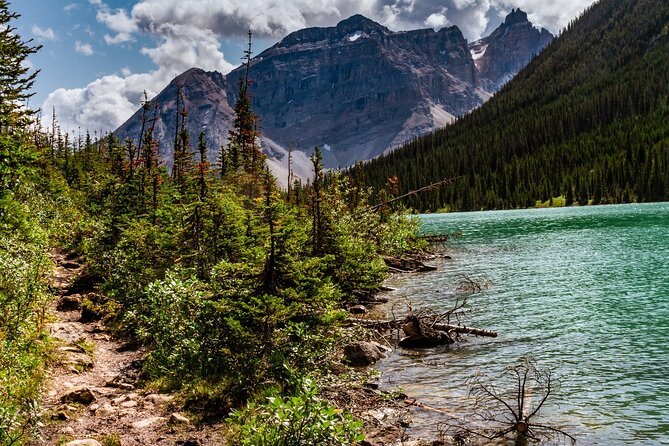
Kicking Horse Pass: why it’s called Kicking Horse
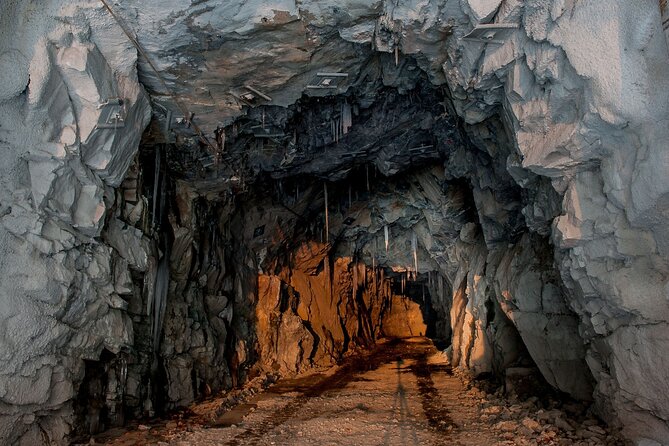
You start with Kicking Horse Pass, a classic mountain crossing route tied to Indigenous travel in the region long ago. The audio frames it as a land-crossing moment toward Banff and then pivots to the question that gives the pass its name: how it became known as Kicking Horse.
Why I like this first stop as a starting point: it sets the tone. You’re not just “arriving at scenery.” You’re getting a sense of how people moved through these mountains, then you’re invited to think about the name itself. It’s a quick way to start seeing the park as a place with layers, not just a backdrop.
You can also read our reviews of more tours and experiences in Alberta
Sherbrooke Lake Trailhead: a quick story, or a real hike
The next waypoint is the Sherbrooke Lake Trailhead. The audio tees up Sherbrooke Lake as a more secluded destination—rarely crowded—and framed as a lake sitting at the base of two mountains for strong views.
Here’s the timing reality: the trail to Sherbrooke Lake is described as six miles long and takes at least two hours. Since the tour stop itself is only a short window for the story, you’ll need to decide how you want to play it:
- If you want a quick nature break: enjoy the viewpoint and move on.
- If you want the actual lake: plan for a longer day and treat this as your mini-adventure, not a brief stop.
This is one of those “your day, your choice” moments that makes a self-guided route feel more flexible than a strict itinerary.
Lower Spiral Tunnel Viewpoint: rail engineering meets mountain scale
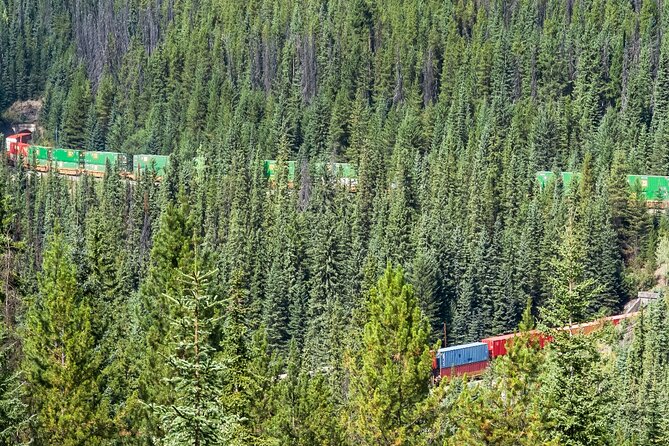
Next up is the Lower Spiral Tunnel Viewpoint, built around the big 1880s challenge of getting a transcontinental railway through the Rockies. The story names Canadian Prime Minister John MacDonald and the Canadian Pacific Railway company, then asks the key problem: how do you move a steam-powered train with about 20 cars over mountains around 10,000 feet tall?
This is where the audio does something useful: it connects geology and infrastructure. You’re looking at a place shaped by the need to conquer elevation. The viewpoint itself is a short stop, but the story makes it easier to appreciate why this engineering solution mattered—and how hard it must have been to execute in real time.
Takakkaw Falls detour: only in July to September
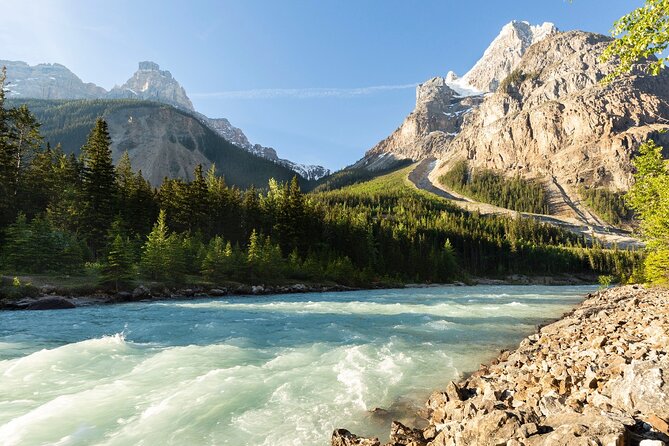
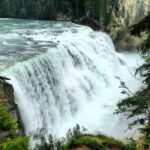
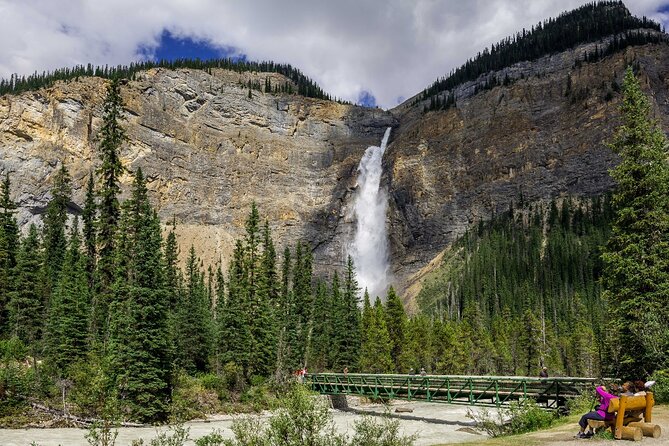
After the tunnel stop, you get an option for a detour to Takakkaw Falls. The road is only open July through September, so this is very seasonal. The detour is described as about 15 minutes each way, and the falls are listed at a staggering 1,200 feet. You can also get surprisingly close to the water.
This detour is worth flagging because it affects your plan. If you’re traveling outside July to September, you’ll miss the chance at Takakkaw Falls via this route. If you are in-season, the time trade feels good: a short drive adds a payoff that’s visually dramatic and hard to replicate with a quick pull-off.
Wapta Mountain: a First Nations name with mountain cred
You’ll round a bend and see the top of Wapta Mountain. The peak is listed at 9,114 feet. The story points to a first climb in 1901 by clergyman James Outram and his friend J.H. Scattergood, done with a Swiss guide.
What makes this one more than trivia is the naming angle. The audio notes that many nearby mountains have European names, but this one actually has a First Nations name. Then it poses a direct question: what “wapta” means in the Nakoda language. Even if you don’t know the answer, the prompt is a good way to stay alert instead of letting the audio become background noise.
Burgess Shale: fossils and the scale of geologic time
At Burgess Shale, the audio shifts into paleontology. Mount Field is referenced as home to one of Canada’s most important fossil finds, and Burgess Shale is described as sedimentary shale loaded with fossils.
For many people, a fossil stop can feel like a museum moment that’s hard to visualize outdoors. Here, you at least get the right mental framing: you’re not just looking at rock—you’re seeing a formation known for what it contains. If you’ve ever been curious why this area is so significant in geology and science conversations, this is the “aha” waypoint.
Natural Bridge: how the Kicking Horse River shapes the rock
Next is a viewpoint for Natural Bridge, a rock bridge spanning the width of the Kicking Horse River. The audio focuses on how it formed, using the river’s speed and slope changes as the explanation.
The story walks you through a simple pattern: near Field, the river flowed flatter ground like a slower-moving system. Then around here it begins a downhill journey to join with the Amiskwi River, gravity adds speed, and the flow becomes rougher. That change in water power over time is the logic behind how rock can be carved and shaped in dramatic ways.
This is another good example of why location-triggered audio helps. You’re learning while you’re literally looking at the geography the story depends on.
Emerald Lake finale with Tom Wilson
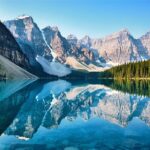
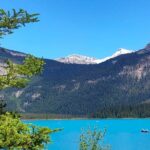
Your final destination is Emerald Lake. The audio ends with Tom Wilson, described as the first European settler to lay eyes on the lake, and even naming it. The story also mentions historians are pretty sure he isn’t lying about that discovery.
This last stop works well because it gives you a natural “reset” after science and engineering chapters. You’ve had rail engineering, fossils, river formation, and mountain naming. Then you finish with a famous glacial lake moment—calm, scenic, and easy to linger at.
Price and value: what $14.99 per group really gets you
At $14.99 per group (up to 4), the tour’s value comes down to two things: time and flexibility.
Time: the full audio route is planned for about 1 to 2 hours, and it hits multiple standout areas within the park. If you’re already planning a drive through Yoho, you’re buying meaning for the drive instead of paying for someone to steer you.
Flexibility: you’re not on a schedule set by a guide. You can stop, pause, and take side breaks without feeling like you’re wasting someone else’s time. That matters a lot in parks, where the best moments are often unplanned: a cloud break, a better view angle, or simply wanting more time at a waterfall.
Also, buying per car is the right kind of pricing for families and small groups. If you were splitting the cost among multiple people anyway, the “per group” structure is a big part of why the price stays competitive.
One other “value” point: you get offline maps and self-guided playback, which reduces stress. Less stress usually equals more patience for scenery and fewer rushed stops.
Who should book this Yoho audio tour
This tour fits best if you:
- Prefer a self-paced road trip over joining a group schedule
- Want a simple way to understand Yoho’s history and geology without committing to a long hike every stop
- Are traveling as a carload (up to four people) and want a cost that scales well
It’s also a solid pick if you’re doing a larger Canadian Rockies loop and want a dedicated Yoho experience that isn’t dependent on a live tour guide.
If you’re the type who hates downloading apps and handling setup steps, take that seriously before you buy. The audio is the core product, and it requires the phone to be set up properly in advance.
Practical tips for a smoother day on these roads
- Download before you enter the park: the tour is designed for offline use after download, but it needs strong connectivity first.
- Bring a charging cable and keep the phone where you can see it briefly if you need to troubleshoot.
- Use the phone audio through your car stereo if you can. For walk-and-view moments, headphones can help, especially if the car’s parked but you’re taking short walks.
- If you want Sherbrooke Lake, plan it like a hike day segment (6 miles and at least two hours is the stated expectation).
- If Takakkaw Falls matters to you, check the July-to-September road-open window before you plan your day.
Should you book this Yoho National Park self-guided driving audio tour?
If your plan includes driving through Yoho anyway, I’d book this. The price per group makes sense, the audio is location-triggered so you don’t feel lost, and the stops cover a strong mix: mountain pass origins, tunnel-era engineering, a seasonal waterfall detour, fossils, river formation, and then a classic Emerald Lake finish.
The main reason not to book is if you know your phone setup often goes sideways: weak download connection, poor GPS reception, or you hate app-based steps. If that’s you, either plan to download early on solid Wi‑Fi or be ready to treat the first part of the day as setup time.
If everything clicks, you’ll get a Yoho drive that feels smarter than a random loop and calmer than a strict guided schedule.
FAQ
Is a Yoho National Park entrance pass included?
No. A park pass is required to visit Yoho National Park, and it is not included with the tour.
How much does the Yoho driving audio tour cost?
It’s priced at $14.99 per group, up to 4 people.
How long does the tour take?
The duration is about 1 to 2 hours, approximately, to complete the full route with its stories.
Where does the tour start and end?
It starts at CRHF+Q24, Lake Louise, AB T0L 1E0, Canada, and it ends at Emerald Lake Road in Field, BC V0A 1G0, Canada.
Do I need cell service to use the audio?
No. It includes offline maps, and it’s designed to work without signal after you download the tour.
When do I need to download the tour?
You must download the tour while you are on strong Wi‑Fi or cellular connectivity. After download, it’s meant to work offline.
How do I hear the audio in the car?
You can connect your phone to your car stereo using Bluetooth, USB, or AUX. Audio playback is compatible with Apple CarPlay, and Android Auto support is described as coming soon.
Can I start and pause whenever I want?
Yes. The tour is designed for you to start anytime, pause anywhere, and enjoy breaks for photos or snacks, then continue at your own pace.
What’s the cancellation policy?
You can cancel for a full refund if you cancel up to 24 hours in advance of the experience’s start time. If you cancel less than 24 hours before, the amount paid isn’t refunded.