REVIEW · BANFF
The Sights of Banff: a Smartphone Audio Walking Tour
Book on Viator →Operated by Tripvia Tours · Bookable on Viator
Banff sounds better when you can wander. This smartphone audio tour lets you explore Banff at your pace while an app guides you from stop to stop with automatic audio. I like that it feels like a guided walk without the tight-group pressure.
Two things I really like: offline playback after downloading, and the live GPS map that shows you where you are and what’s next. One thing to weigh is that the experience depends on app performance and clear placement at each corner, so it can feel a bit clunky at first.
The route is built around Banff’s core—historic buildings, parks, and river views—starting near Banff Avenue and looping back to the same spot. You’ll get audio that plays when you’re close, plus a small location-based trivia game to keep you paying attention.
For me, the best part is the balance: a bit of context at each site, but not so long that you feel stuck at one spot.
The main drawback is the human factor of technology and timing. If the app interface struggles, or if you’re trying to follow in poor weather, you can waste time before the audio triggers correctly. I’d especially plan for that if you’re doing this in winter cold like the -19 C conditions that made one walk-through harder.
In This Review
- Key things to know before you start
- A smartphone tour that plays like your personal guide
- Start at 12 Banff Ave, then follow the loop through the center
- How the audio triggers, plus the trivia game
- Buffalo Nations Museum to the Administration Building: Banff’s civic roots
- Cascade Gardens and the Bow River views: pretty breaks between stories
- Elevation markers, historic cabins, and early power: small details that matter
- Luxton Home Museum and the pioneer-era streetscape
- Visitor Information Centre to Central Park: practical breaks with real context
- Banff Park Museum and the heritage blocks along Banff Avenue
- Price and value: what $8.22 gets you in Banff
- App and timing tips (based on common snags)
- Should you book this Banff smartphone audio walk?
- FAQ
- How long does the Banff smartphone audio walking tour take?
- Where does the tour start?
- What time of day can I start?
- Do I need internet data during the tour?
- Is the tour audio in English?
- Will I need headphones?
- Can I start at different times or take breaks?
- Are attraction tickets included?
- Is it a private tour?
- Can the app work on multiple devices?
- Is there any accessibility or participation guidance?
Key things to know before you start

- Offline-friendly audio after you download on Wi-Fi first
- Automatic GPS-triggered commentary as you get near each stop
- Stop and start anywhere with no set clock forcing you along
- A trivia game at the right moments to keep things lively
- Admission varies by stop, so some places may cost extra
- App learning curve: it can take a few minutes to get used to
A smartphone tour that plays like your personal guide
This is a classic Banff downtown walk, but the guide lives in your phone. Once you download the tour, the app can work without signal, which is ideal when you’re moving between corners and along busier blocks. The audio is location-based, so you don’t have to press play every time. You simply walk, and commentary begins when you’re close.
I also like that the tour is built to match how people actually travel. You can pause, detour, or linger at photos, and the route doesn’t punish you. That’s a big deal in Banff, where you can easily get distracted by the scenery, the shops, or the river.
Still, this format means your experience hinges on your ability to follow the route clearly on-screen. One common frustration is thinking you’re at the right spot but hearing nothing—often solved by a little patience and careful positioning at the exact corner.
You can also read our reviews of more walking tours in Banff


Start at 12 Banff Ave, then follow the loop through the center

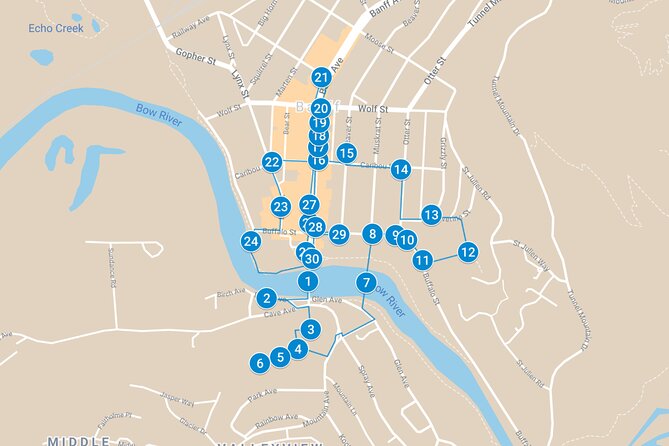
You begin at 12 Banff Ave and finish back at the meeting point. The whole experience is about 1 to 1.5 hours for the core route, and it’s described as a 5 km return sightseeing walk from the first museum stop. Expect frequent short stops—many are around 5 minutes, with one longer garden segment.
Because the tour is designed to be flexible, it’s not like a rigid guided group schedule. The app gives you a live GPS map that tracks your position and shows where you go next, and commentary plays as you arrive near each attraction. The practical upside: you don’t need to constantly look up street names or compare multiple maps.
The practical downside: don’t assume the on-screen navigation alone will always feel perfect. A few visitors flagged that the map and direction prompts weren’t always straightforward, so your best friend is slow, careful corner-to-corner walking. If you get turned around, step back and confirm you’re aligned with the next pin/stop.
How the audio triggers, plus the trivia game

At each point of interest, the tour guide commentary is triggered automatically when you get close. That means less fiddling and fewer missed stories—especially when you’re balancing sightseeing with actually reading what’s in front of you.
To keep you engaged, there’s also a location-based trivia game. After the commentary plays, you look at your screen and tap your guess at the answer. It’s a small touch, but it changes the vibe from passive listening to active attention.
If the audio doesn’t start when you expect, try this approach: stand near the spot, wait a moment, then adjust your position slightly. Many “it didn’t play” moments are really “I was a few steps off.”
Buffalo Nations Museum to the Administration Building: Banff’s civic roots
Stop 1 is the Buffalo Nations Museum. Here you’re guided through a blend of Banff’s past and present, with highlights including the Banff Administration Building, the Luxton Home Museum, Central Park, and the Cascades of Time Gardens (all of which appear later on the walk). It also frames the whole town with a sense of place—history you can then spot in the streets around you.
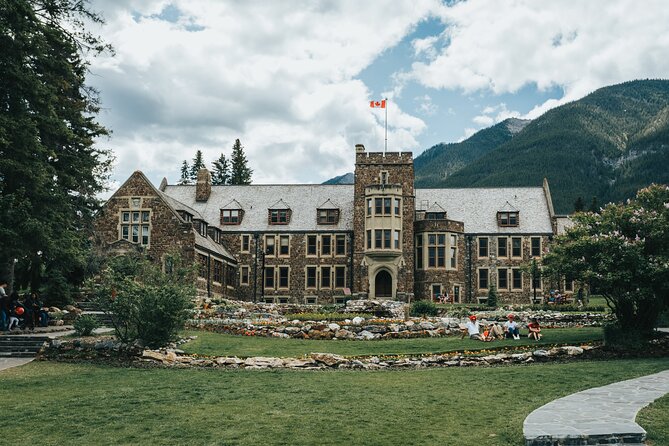
Stop 2 focuses on the Banff National Park Administration Building. This is a photo-friendly moment: you’re basically encouraged to stare at the building while the audio explains what makes it special.
If you’re deciding whether this tour is worth doing, these first two stops set the tone well. They turn Banff Avenue from just a street into a story trail—so later, when you see a cabin or a mural, it lands with meaning instead of just being another old building.
Cascade Gardens and the Bow River views: pretty breaks between stories
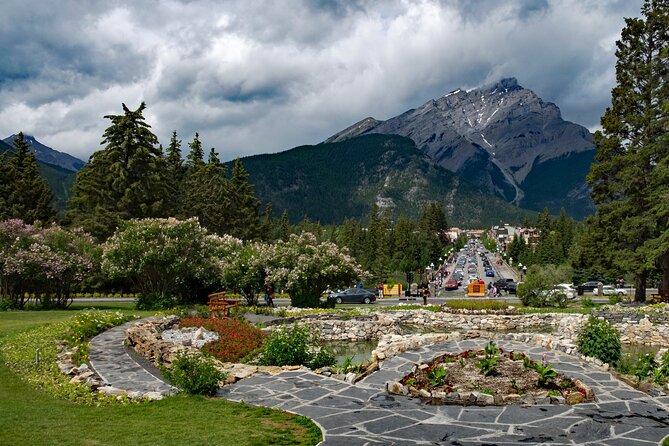
Stop 3 is Cascade Gardens, a 4-acre hillside park built in the 1930s. The tour breaks your attention into two points: the Cambrian and Devonian pavilions. Even if you’re not a garden super-fan, the audio here helps you understand why this specific design matters.
Stop 4 is the Banff Pedestrian Bridge, with views over the Bow River. The commentary ties this moment to the man known as Mr. Banff, turning a simple river view into a quick cultural reference point.
If you’re visiting in warm weather, this part can be the easiest to enjoy on a phone tour—because the scenery does the heavy lifting. In cold weather, though, these pauses can turn into endurance tests. One review specifically called out that extreme temperatures made walking tough and caused them to miss parts, so plan your pace accordingly.
You can also read our reviews of more tours and experiences in Banff



Elevation markers, historic cabins, and early power: small details that matter
Stop 5 takes you to Buffalo Street & Muskrat Street to hunt for an elevation marker—it looks like a coin embedded in the sidewalk. This is the kind of “spot it with your own eyes” moment that makes the audio tour feel hands-on instead of abstract.
Stop 6 is 514 Buffalo St, pointing out the Crandell Peck Cabin, built in 1907 by Edward Henry Crandell using mostly locally sourced materials. Stop 7 then shifts to Buffalo Street & Otter Street, where you’ll spot an inukshuk and learn what you’re looking at.
Stop 8 (at 525 Buffalo St #521) adds a different kind of history: you learn about the Banff Powerstation and how it powered streetlights and homes in 1905. That’s a fun contrast after the older wooden cabin—same downtown, totally different era of change.
Stop 9 heads onto Ken Madsen Path, keeping the Banff story going with more context as you walk. Stop 10 (at 117 Grizzly St) points out the Tarry-a-while residence, connected to Mary Schaffer Warren and her early explorations, writings, and paintings about the Canadian Rockies.
These are short stops, but they add up. You’re not only hearing about Banff—you’re training your eye to notice the built details that most people walk past without a second look.
Luxton Home Museum and the pioneer-era streetscape

Stop 12 is the Luxton Home Museum, a pioneer family home covering life over nine decades. The tour notes that admission for this stop is not included, so you should expect extra cost if you go inside. Stop 11 (Otter Street & Caribou Street) comes right before it and covers Banff’s climate, which sets you up for understanding why buildings and life here worked the way they did.
Stop 13 (Caribou Street & Banff Avenue) highlights Caribou Corner and the Brewster family arriving in 1886 and setting up shop. Stop 14 (204 Banff Ave) brings you to the four sentries sculpture. Stop 15 (Box 3100) features a large mural on Banff Avenue depicting the Cave & Basin site.
This cluster is a good example of why the “short audio at many sites” approach works. You’re mentally collecting small anchors—sculpture, family history, a mural, a climate note—so the downtown feels cohesive rather than random.
Visitor Information Centre to Central Park: practical breaks with real context

Stop 16 is the Banff Visitor Information Centre. It’s not just a landmark; it’s your chance to sanity-check your next plans after you’ve gathered background from the walk.
Stop 17 is St. Paul’s Presbyterian Church, built in 1930, with roots going back to 1887. Stop 18 (Banff Avenue & Elk Street) points out a stone fire seat/monument area, with the audio focusing on what it represents.
Stop 19 (Caribou Street & Bear Street) references the old Cascade lodge, once home to the Banff Freemasons. Stop 20 is the Whyte Museum of the Canadian Rockies, which aims to preserve and make accessible Rocky Mountain history and culture. Admission is not included here too, so if you want museum time, budget for it.
Stop 21 is Central Park, where the audio gets a bit humorous, calling attention to a big pile of rocks in the middle. It’s a funny reset point, and it can also be a good time to pause the walk for photos before the last museum stop.
Banff Park Museum and the heritage blocks along Banff Avenue
Stop 22 is the Banff Park Museum, tied to a National Historic Site of Canada established in 1895, with a focus on taxidermy specimens of animals, plants, and minerals associated with the park. Like the other museum stops marked as not included, it likely requires extra admission if you want to go in.
Stop 23 takes you to Banff Avenue & Buffalo Street to see the Dave Whyte block, described as one of the oldest remaining commercial buildings in Banff, largely intact. Stop 24 (107 Banff Ave) highlights Harmony Lane, built in a rustic National Park style with river stone pillars.
Stop 25 is Rundle United (Ralph Connor Memorial United Church), where the audio references the man behind the church’s name, with a playful Mr. Rundle bit delivered by the tour guide voice (Don is named in one of the audio moments).
Stop 26 (Beaver Street & Buffalo Street) points out the Superintendent’s Residence, tying it to the responsibilities of the park superintendent. Stop 27 is the Royal Canadian Legion Col. Moore Branch 26, finishing at the cenotaph built in front in 1920.
By the end, you’ve walked from early civic structures to heritage commercial buildings to living memorials. That makes the closing feel meaningful, not just like a return walk.
Price and value: what $8.22 gets you in Banff
At $8.22 per person, this tour is priced like a budget-friendly way to add structure to your day. The real value is not only the audio—it’s the control. You’re paying for a route, timed stops, GPS guidance, and commentary that you can repeat anytime later because it’s treated as a mobile tour you keep access to.
It also helps that lots of stops are free to view externally. You’ll still want to consider extra costs at the stops where admission is not included, especially if you plan to enter the Buffalo Nations Museum, Luxton Home Museum, Whyte Museum, or Banff Park Museum.
So here’s the honest take: it’s a great deal if you’re okay with spending most of your time outside and using museum stops as optional upgrades. If you want a fully ticketed museum day, the price can creep upward once you add entry fees.
App and timing tips (based on common snags)
This tour can be smooth once you get the hang of it. But based on what’s been flagged, I’d go in expecting a short learning period.
- Start with calm pace. The initial setup can feel confusing until you understand how the pins and audio triggers work.
- If the app interface jumps or lags, it may interrupt your flow. Give it a moment and re-check where you are relative to the next stop.
- Some stories may feel long or repetitive if you stop for photos slowly. If that happens, just keep moving to let the next audio cue come.
- In very cold weather, walking can slow you down. If conditions are harsh, you may want to shorten your walking time and hit only the most important exterior sights first.
Bring a headphone if you prefer audio clarity, but it’s not required since the audio can play from your phone’s speaker. Either way, this is a do-it-your-way format—just protect it from “friction time,” like waiting at the wrong corner.
Should you book this Banff smartphone audio walk?
Book it if you want an affordable, flexible way to understand downtown Banff without joining a crowd. The mix of GPS-triggered audio, short stops, and a fun trivia moment makes it easy to stay interested even when you’re just doing a half-day.
Skip it or only partially do it if:
- you strongly dislike phone-based navigation,
- you’re traveling in extreme weather where walking every stop might be unrealistic, or
- you expect a flawless app experience at every step.
For most people who want a guided-feeling walk at a low price—this is a smart fit, especially if you like historic streets, scenic breaks over the Bow River, and learning how Banff’s downtown ties together.
FAQ
How long does the Banff smartphone audio walking tour take?
It’s listed as about 1 hour to 1 hour 30 minutes.
Where does the tour start?
The meeting point is 12 Banff Ave, Banff, AB T1L 1A1, Canada.
What time of day can I start?
The activity is shown as available Monday through Sunday from 12:00 AM to 11:30 PM.
Do I need internet data during the tour?
No. The download is done on Wi-Fi before you start, and during the tour it’s designed to work without signal and without data use.
Is the tour audio in English?
Yes, it’s offered in English.
Will I need headphones?
Headphones are not included. Audio can play from your device speaker as well, so headphones are optional.
Can I start at different times or take breaks?
Yes. You have a flexible start time, no time constraints, and you can stop and start anywhere along the route.
Are attraction tickets included?
Not always. Some stops are free to view, but admission is not included for certain attractions like the Buffalo Nations Museum, Luxton Home Museum, Whyte Museum of the Canadian Rockies, and Banff Park Museum.
Is it a private tour?
Yes. It’s described as private, so only your group participates.
Can the app work on multiple devices?
The number of travelers you select matches the number of devices that can download the tour.
Is there any accessibility or participation guidance?
Most people can participate, and service animals are allowed.